
Scorecard builder
Describe the rubric you want, or start from a framework, then tune it against real calls.
Scoring → Scorecards lists your evaluation templates in two groups: Featured templates that ship with the product, and Your organization — the ones you've created. New evaluation starts a fresh one. Archived templates are hidden behind Show archived.
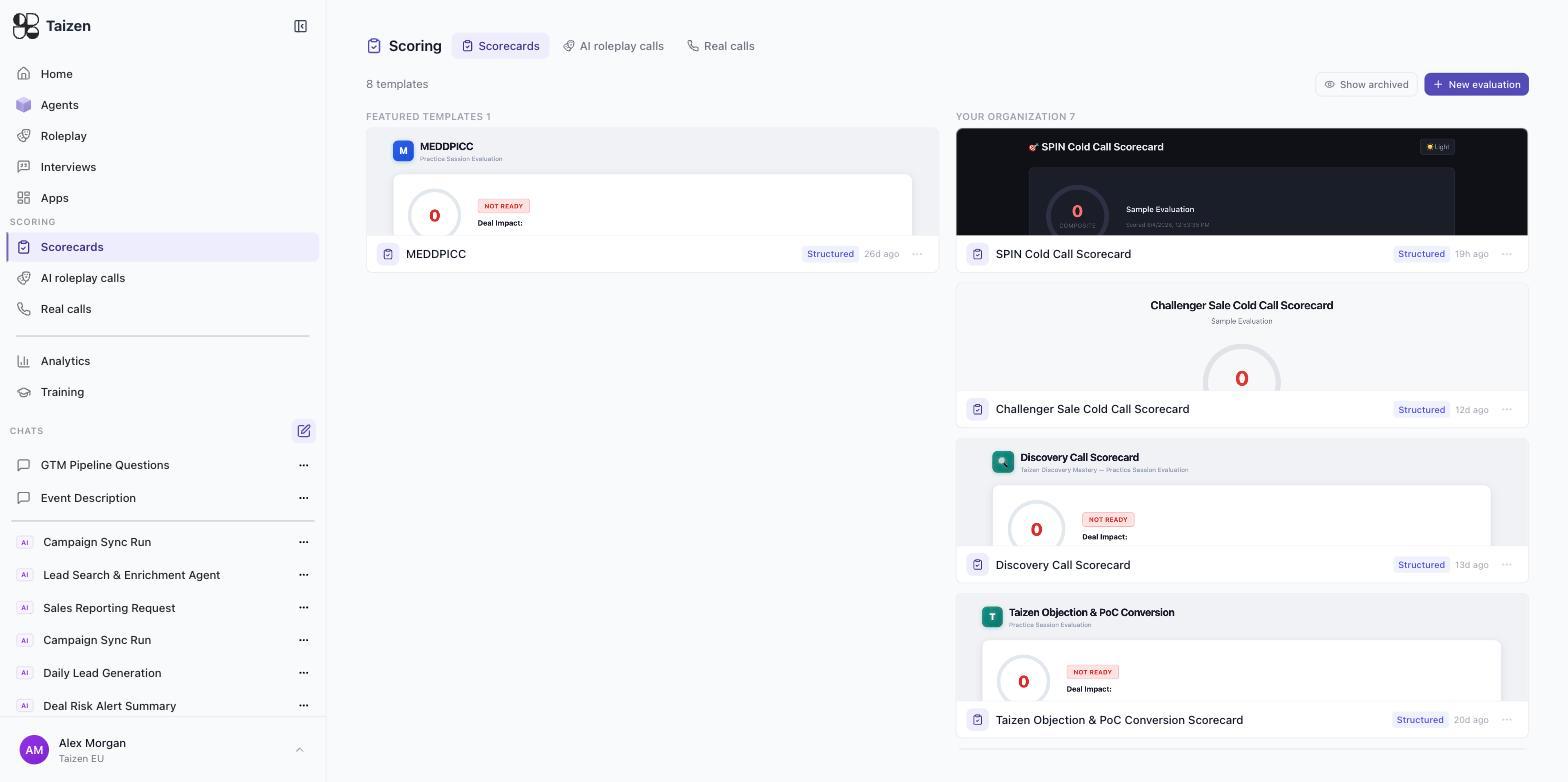
Each card previews the report that scorecard produces — the score dial, the readiness badge and the section headings — so you can tell them apart at a glance rather than by name alone.
Build one
Start from a framework, not from nothing
Pick the featured framework closest to how your team already sells and adapt it. A rubric written from scratch usually ends up being a list of everything, weighted equally, which scores nothing usefully.
See frameworks.
Describe the rubric you want
The builder is a chat. Describe the call type and what a good one looks like:
A discovery call scorecard for mid-market deals. Score five dimensions:
discovery depth, pain quantification, value articulation, objection handling,
and securing a specific next step.

Weight discovery depth and pain quantification highest — those are what our
lost deals keep failing on. A pass is 70.

Mark a call down if the rep pitched before understanding the problem, or left
without a date for the next conversation.
Name what fails, not just what passes
The most common weakness in a rubric is that it only describes excellence. Say explicitly what should pull a score down. That's what makes a judge's ratings consistent between two calls that both "went fine".
Test it on a real call you already have an opinion about
Score a call you've listened to. Then read the evidence for each dimension — not the number, the citation. If the judge cites moments you'd have cited, the rubric works. If it's citing rapport as evidence for discovery depth, your dimension definitions overlap and need separating.
Then attach it
Attach it to roleplay steps in a training plan, and use it for real calls. Same rubric, both surfaces.
Anatomy of a good rubric
- Four to six dimensions. Fewer and it doesn't diagnose; more and nobody reads the breakdown.
- Dimensions that don't overlap. "Communication" and "rapport" as separate dimensions will always move together and tell you nothing extra.
- Weights that reflect your losses. If competitive losses are your problem, objection handling shouldn't be weighted the same as note-taking.
- A defined pass mark, so it can drive a pass gate.
- Explicit failure conditions. "Pitched before discovering", "left without a next step", "quoted pricing not in the price book".
Structured templates
Templates are Structured — the rubric has explicit dimensions and rules rather than being a freeform instruction. That's what makes two calls scored a week apart comparable, and what lets the dashboard break a team average down by dimension.
Keeping scorecards honest over time
- Version deliberately. Editing a live scorecard changes what a score means. If you're making a material change mid-quarter, create a new template rather than mutating the one your training plans reference.
- Archive rather than delete. Archived templates keep historical scores interpretable.
- Revisit after a competitive shift. When a competitor changes their pitch, your objection-handling dimension is now testing for the wrong objection (competitive watchlist).
One rubric per call type
Don't try to make one scorecard cover cold calls, discovery, demos and renewals. The featured set and the example templates in a mature workspace look like this for a reason:
- Discovery call scorecard
- Demo relevance and storytelling
- Objection and PoC conversion
- Platform walkthrough
- Cold call (per framework — Challenger, SPIN)
- Renewals practice
A rep's demo score and their cold-call score are different skills, and the coaching is different too.