
Scoring overview
One rubric across practice roleplays and real customer calls, with evidence for every rating.
Taizen scores practice calls and real calls on the same rubric. That single decision is what makes the rest of the platform measurable: you can see whether the drilling changed how a rep actually sells, rather than how they perform in a mock.
The screen
Scoring in the sidebar, three tabs:
| Tab | What's in it |
|---|---|
| Scorecards | Your evaluation templates — the rubrics themselves |
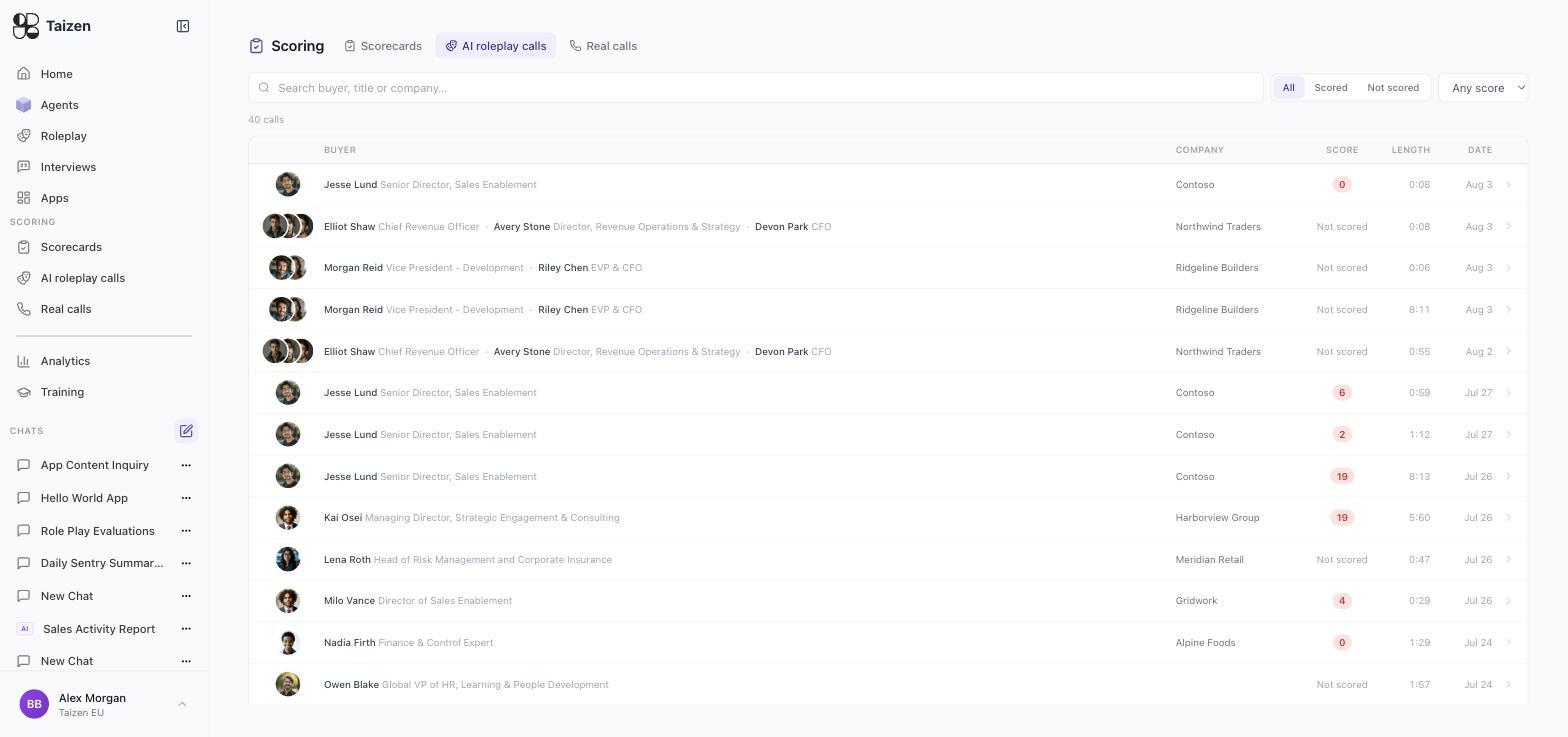
| AI roleplay calls | Every practice session, with score, length and date |
| Real calls | Customer calls from your call source, scored on the same templates |
On the roleplay and real-call tabs you can filter to Scored / Not scored and by score range, and search by buyer, title or company.
What a scorecard is
A scorecard — an evaluation template in the UI — is a rubric: the dimensions you care about, what good looks like on each, and how they're weighted. Featured templates ship with the product; the rest belong to your organization and are yours to edit.
Typical dimensions, as they appear on a real dashboard: objection handling, value articulation, discovery depth, advancing the deal, communication rapport.
Who does the scoring
An AI judge, against your rubric. Every rating has to cite the exact moment in the transcript it came from, so you can check its reasoning instead of taking a number on faith.
It's built to be strict. Sessions fail, and a failing score with evidence is more useful to a manager than a generous one. See how scoring works.
Where scores show up
- Session review after a roleplay, with the transcript and replay (scores and feedback)
- Scoring → AI roleplay calls and Real calls, as workspace-wide lists
- Analytics → Training, aggregated per plan: team average, score by dimension, coaching priority (performance)
- Pass gates in training plans, where a score decides whether the next stage unlocks (stages and pass gates)
The comparison that matters
Put a rep's practice scores next to their real-call scores on the same dimensions. Three outcomes, three different actions:
| Practice | Real calls | What it means |
|---|---|---|
| Up | Up | The drills are transferring. Keep going |
| Up | Flat | They're learning to pass the bot. Change the scenarios, not the rep |
| Flat | Up | The plan isn't testing what the job requires |
That table is the reason both surfaces share one rubric.
Start here
- Pick a framework close to how you sell — MEDDPICC, Challenger, SPIN or BANT (frameworks)
- Adjust the wording to your product and market (scorecard builder)
- Score one roleplay and one real call with it, and read the evidence rather than the total
- Only then attach it to a training plan