
Document stores
Named collections of documents that roleplay buyers, training plans and agents read from.
Settings → Knowledge holds your document stores: named collections of documents the products read from. They're the grounding that makes a roleplay buyer object to your real prices and a training plan teach your actual playbook.
The screen
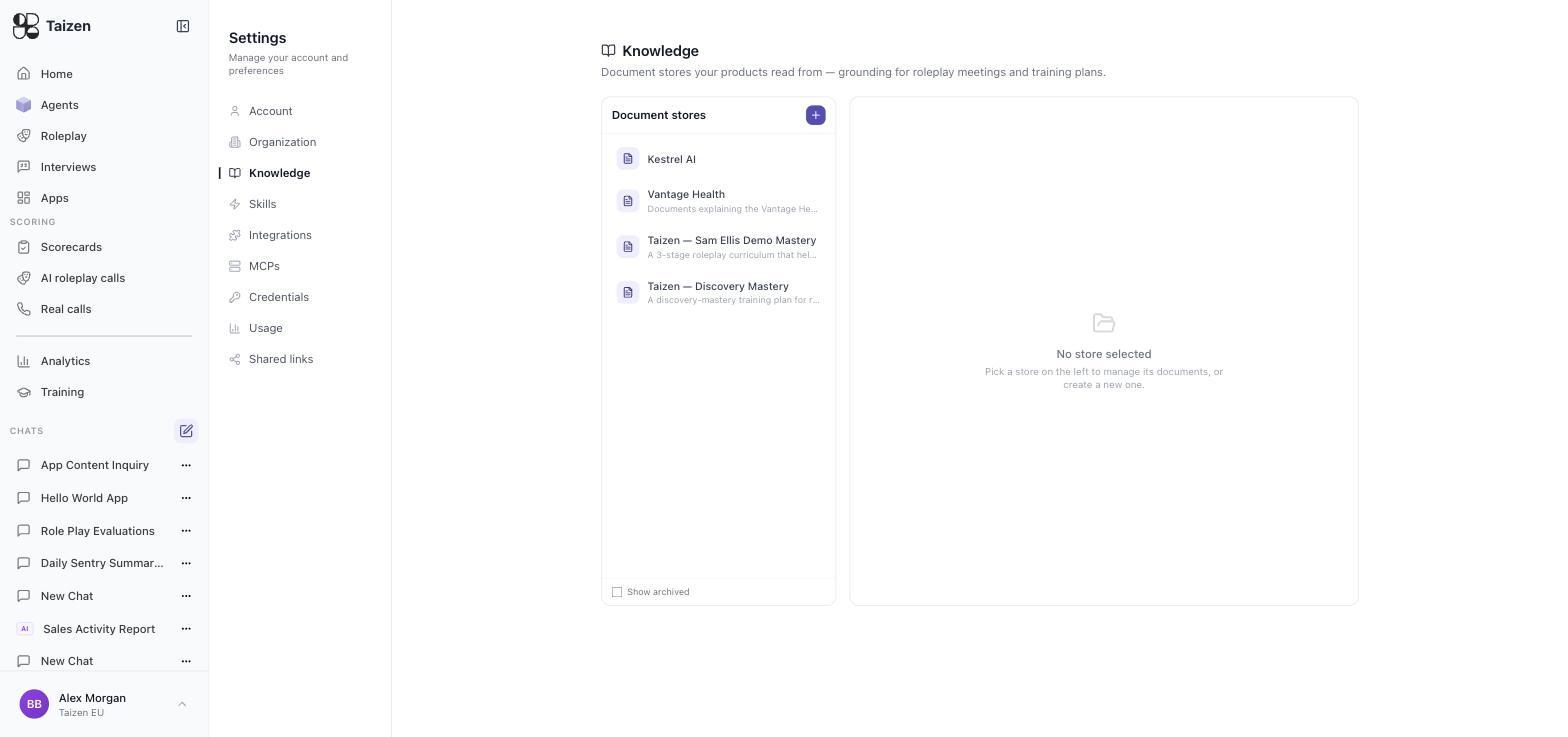
A list of stores on the left, the selected store's documents on the right, a + to create one, and a Show archived toggle.
Each store has a name and a description. The description matters more than it looks — it's how the products decide which store is relevant, so "Documents explaining the enterprise sales motion and pricing" is a better description than "sales stuff".
What to put in
In rough order of value:
- The sales playbook. Call frameworks, qualification criteria, how your team is supposed to run each stage.
- Pricing and packaging. This is what makes a roleplay buyer push back on your real numbers rather than invented ones.
- Competitive one-pagers and battlecards. So the buyer raises the objections your competitors actually coach.
- Product documentation for the parts reps get wrong.
- Customer-facing collateral — case studies, proof points, ROI material.
How to organize stores
One store per body of knowledge, not one per file, and not one giant store.
Patterns that work:
- By motion — "Enterprise sales motion", "Renewals motion"
- By product line — when reps sell distinct products with distinct objections
- Per training plan — a store holding exactly what one plan is grounded in. Each plan shows its Documents, so this keeps the relationship legible
- By customer, for a store built to prep a specific complex account
Avoid organizing by file type or by team that authored it. Nobody reasons that way, and neither do the products.
Who reads them
| Product | Uses stores for |
|---|---|
| Roleplay | Grounding the buyer — your prices, your positioning, your competitors |
| Training | Compiling a playbook into stages and pass rules |
| Agents | Standing reference during a run |
| Ask Taizen | Answering questions about your own material |
Keeping them current
A store with last year's pricing actively teaches reps the wrong thing — worse than an empty store, because everything downstream inherits the error.
- Own it. One person per store, named.
- Review on your own release cadence. When pricing changes, the store changes the same day.
- Archive rather than delete superseded material, so historical scores and sessions stay interpretable.
- Don't mirror your whole drive. A focused store of twenty accurate documents beats two hundred stale ones.
Attachments vs stores
Attaching a document to one chat or one training plan is right for one-off context. Put it in a store when more than one thing needs it, or when it's canonical.
If a roleplay buyer keeps getting your product wrong, check the store before you rewrite the persona. Nine times out of ten it's grounding, not the bot.