
Build a bot
Create an AI buyer from a LinkedIn profile, a CRM contact, or as a synthetic persona.
A bot is an AI buyer. Roleplay → Bots → Create a bot opens the Chat with Taizen panel — bot creation is a conversation, not a form.
From a LinkedIn profile
Paste the profile URL and say what you want:
Build a roleplay persona from this LinkedIn profile: https://www.linkedin.com/in/dwhitmore/Taizen reads the public profile and builds the persona, reporting each step as it goes:
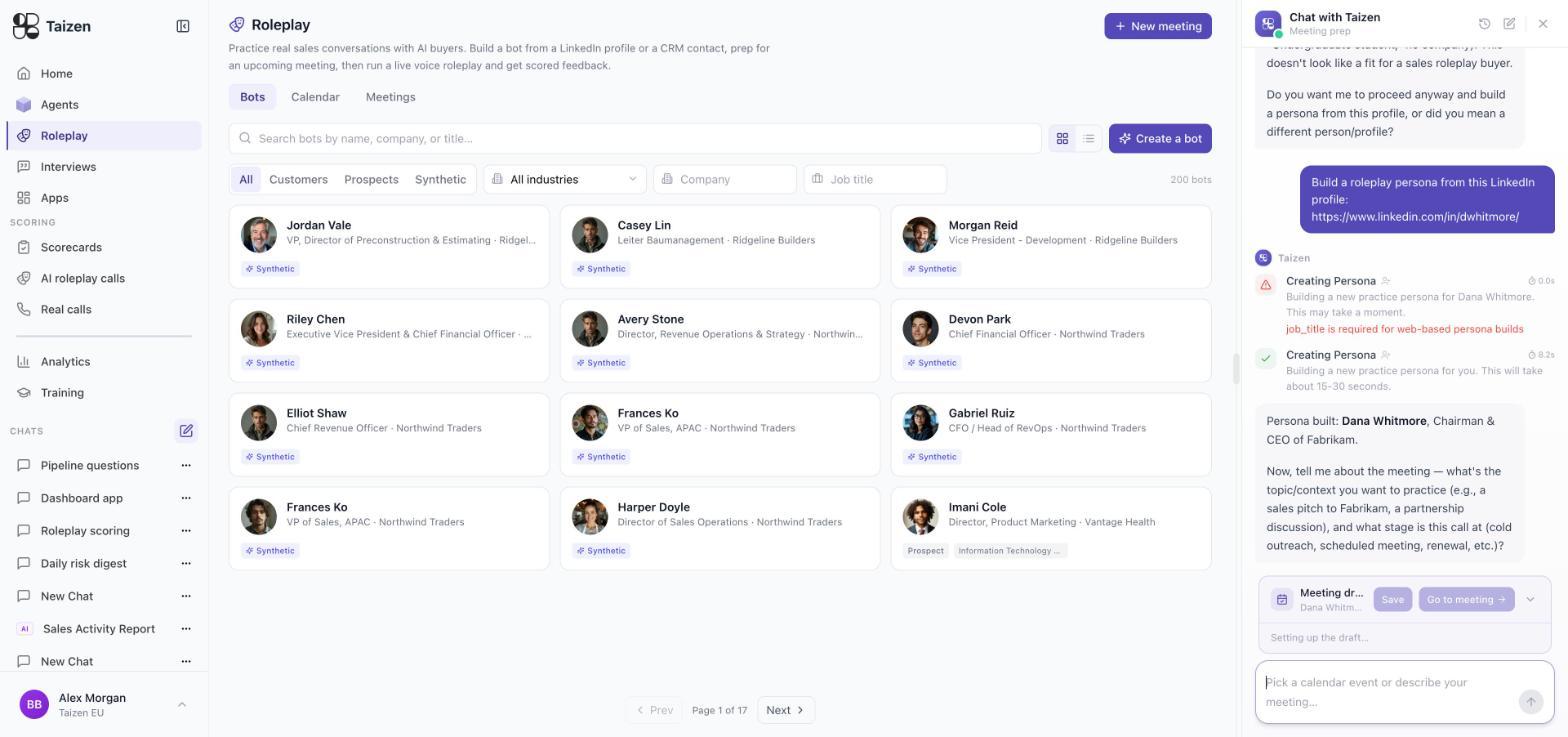
Two things worth knowing from that exchange:
- It sanity-checks the profile. Paste a profile that isn't a plausible buyer — a student, someone with no company or job title — and it says so and asks whether you meant a different person, rather than building a persona nobody would practise against.
- A job title is required. Web-based persona builds need one; if the profile doesn't expose it, supply it.
Then describe the meeting
A persona on its own isn't practice. Taizen asks what you want to rehearse and at what stage:
Cold outreach first call, pitching our AI sales enablement platform.
He is skeptical and short on time.
It records the call type and mood, writes a scenario summary — topic, mood/tags, and the setup the buyer will play ("picks up unexpectedly, doesn't know who you are, gives you a very tight window") — and offers to check evaluation templates or make the buyer tougher before you commit.
Save it
Save on the meeting draft. It confirms the meeting is saved, links you to a practice URL you can share, and the scenario appears in the Meetings tab; Go to meeting takes you straight into the lobby.
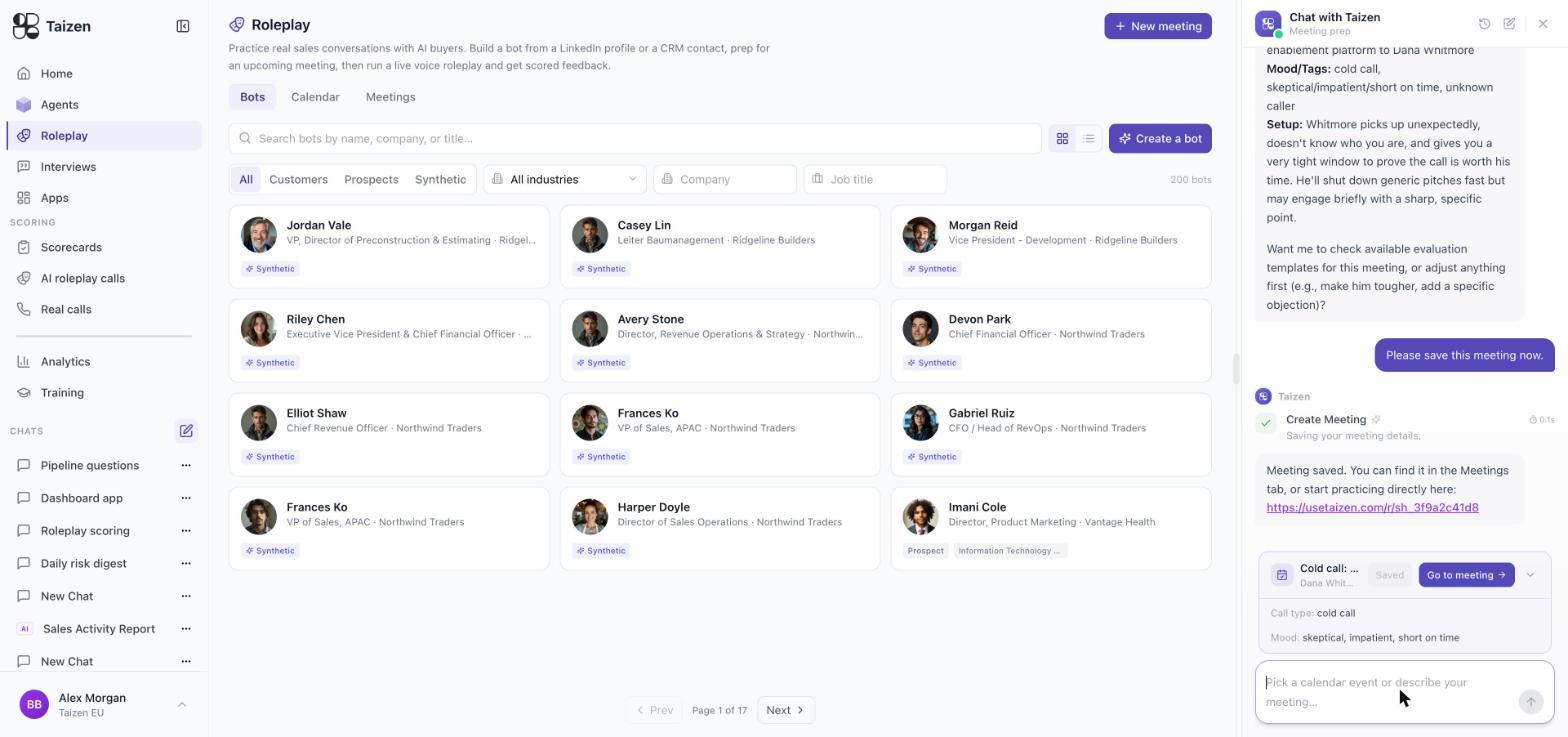
Save stays disabled until the scenario is set. If nothing happens when you click it, Taizen is still waiting for you to answer its question about the meeting — the draft needs a topic and a stage, not just a persona.
From a CRM contact
Ask for the contact instead of pasting a URL — "build a persona from the champion on the Notion deal". The bot inherits everything Taizen knows: the deal, its stage, the call history with that account, the objections raised on those calls, and the competitors mentioned. This is the highest-fidelity option, because the buyer has an actual history with you and will refer to it.
Synthetic
Describe the buyer you want — industry, company size, job title, disposition — and Taizen generates a persona that fits. Best for training at volume and for segments you don't have deals in yet. Synthetic bots are labelled as such in the library so nobody mistakes one for a real account.
What goes into a persona
A useful buyer isn't just a job title. Taizen assembles:
- Role and seniority — a CFO guards budget; a VP of Development wants speed. They ask different questions and concede different things
- Company context — size, industry, what's publicly happening to them
- History with you — past calls, open threads, unanswered questions, previous objections
- Competitive context — who else they're evaluating, and what those competitors are coached to say
- Disposition — receptive, engaged but split, sceptical, hostile
Finding a bot again
The library supports search by name, company or title, plus filters for Customers / Prospects / Synthetic, industry, company and job title. Large libraries paginate — a mature workspace runs to hundreds of bots.
Multi-stakeholder rooms
A real deal is rarely one person. You can put several bots in one meeting, and the session runs as a room with a tile each — here a CRO, a RevOps director and a CFO on one PoC decision call:
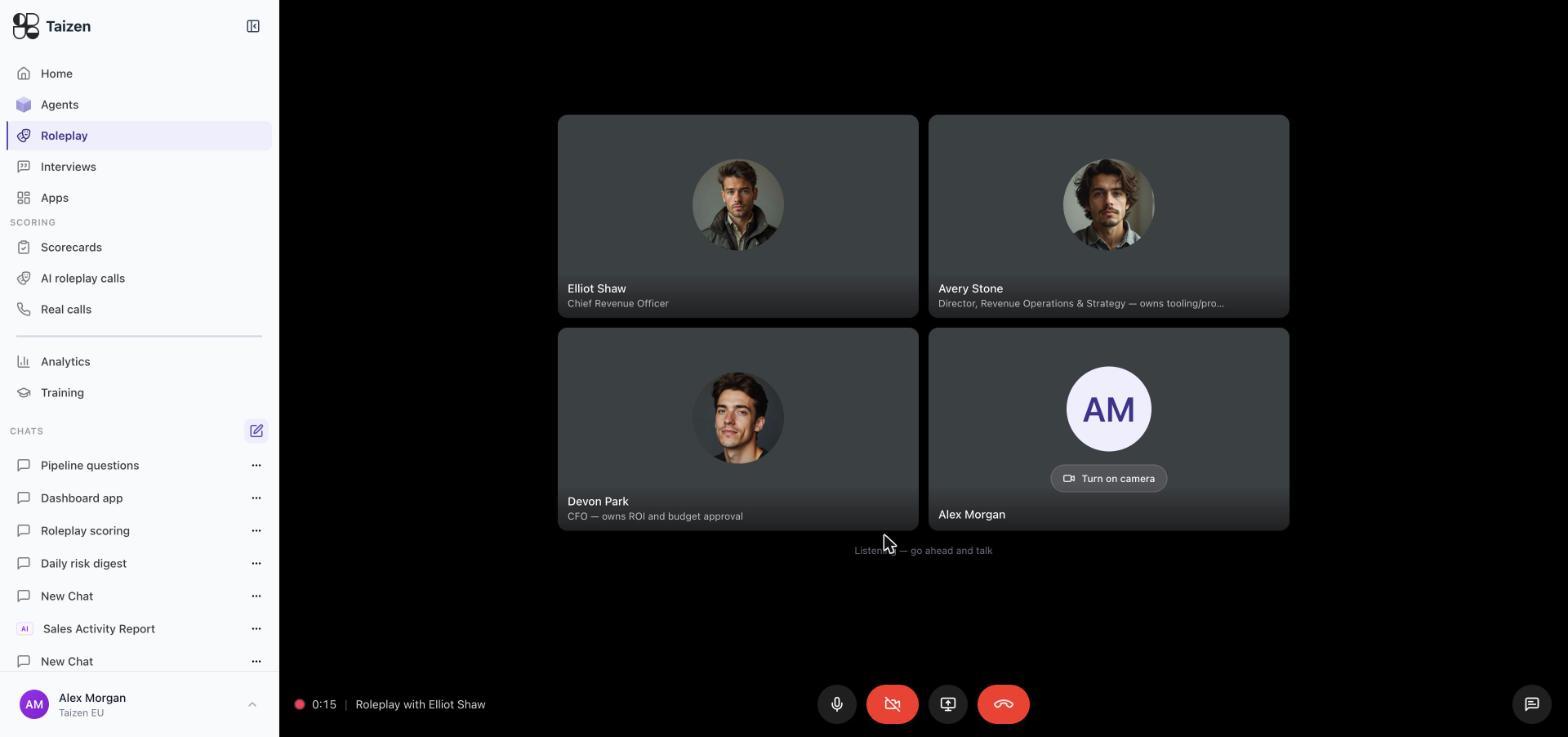
Each tile carries the stakeholder's role in the deal, not just their job title — "owns ROI and budget approval", "owns tooling/procurement". That's what makes the room hard in the right way: the rep has to satisfy the CFO's ROI question without losing the champion who wants speed, and handle the disagreement between them. It's the skill that actually loses deals, and it can't be practised one buyer at a time.
Keep the committee honest. Two verified real stakeholders beat three where one is invented — an imaginary fourth seat teaches reps to handle a person who will never be in the room.
Practical advice
- Build from the CRM when the deal is live. Fidelity matters more than convenience.
- Name bots after the real person for deal prep, and after the archetype ("sceptical CFO, mid-market fintech") for training.
- Don't over-tune the persona. The value is in the buyer being difficult in realistic ways, not in matching a real individual's speech patterns.
- Ground it in documents. Bots read from your document stores, so an accurate pricing sheet means the buyer objects to your real prices.