
Credits and usage
What consumes credits, where to see consumption, and how to keep it predictable.
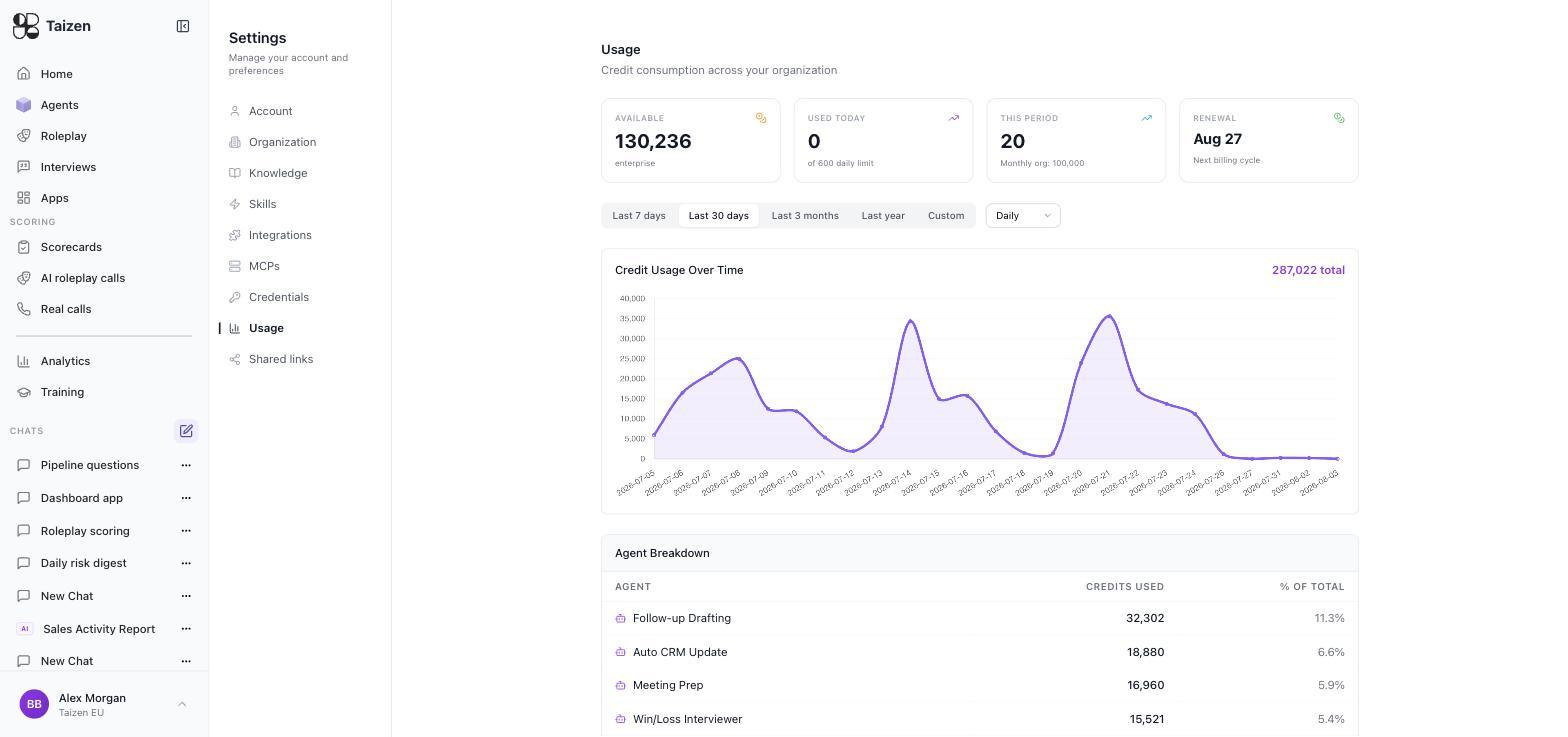
Settings → Usage shows credit consumption across your organization, the current billing cycle, and usage over time. Your remaining balance is also in the top bar of the app.
What consumes credits
Model work. In practice:
- Agent runs. The largest line for most teams, especially event-triggered agents that fire on every call.
- Roleplay sessions. Live voice plus scoring.
- Interviews. Outreach, the voice interview itself, and the analysis.
- Chat. Ask Taizen conversations.
- Real-call scoring. One evaluation per call.
Seeing cost before you commit
You don't have to guess. In the agent builder, every test run shows its own cost to four decimal places, and every real run records cost and duration in the Timeline.
So the reliable estimate for a new agent is: cost of one test run × how often the trigger fires.
The three things that actually move the number
- Model choice. A frontier model on a high-volume event trigger is the most common surprise. Match the model to the work: frontier for synthesis and competitive reasoning, faster models for extraction, summarizing and classification (Ask Taizen → models).
- Trigger frequency. "After every call" on a busy team is hundreds of runs a week. "Hourly, check for new calls" is worse — it burns runs on nothing. Use event triggers for event-shaped work (triggers).
- Scope. An agent that reads every deal when it needs this quarter's deals over $25k costs more and produces worse output.
Keeping it predictable
- Ship agents one at a time and watch the first week's consumption before adding the next.
- Check Agents → Analytics for run volume and success rate per agent. Failed runs still cost.
- Watch for skip-heavy agents. Hundreds of skipped runs means a trigger firing on things it shouldn't (runs and debugging).
- Deactivate rather than delete agents you're pausing — you keep the history and stop the spend.
When consumption jumps
Work backwards:
- Settings → Usage — when did it change?
- Agents → Analytics — which agent's volume changed?
- That agent's Timeline — did the model change, did the trigger start firing more, did runs start failing and retrying?
Nearly every jump traces to one of those three.
A single expensive agent that saves each rep an hour a week is a bargain; twenty cheap agents nobody reads are not. Judge cost against whether anyone acts on the output.