
Training overview
Compile your playbook into a self-certifying journey of escalating roleplays.
An open library of practice scenarios is a tool nobody opens. A training plan is a sequence: the rep works through stages that escalate from a friendly buyer to a hostile one, with a passing score required at each stage before the next unlocks, and a certification at the end.
Managers see who has passed what, so it becomes part of ramp rather than an optional extra.
The screen
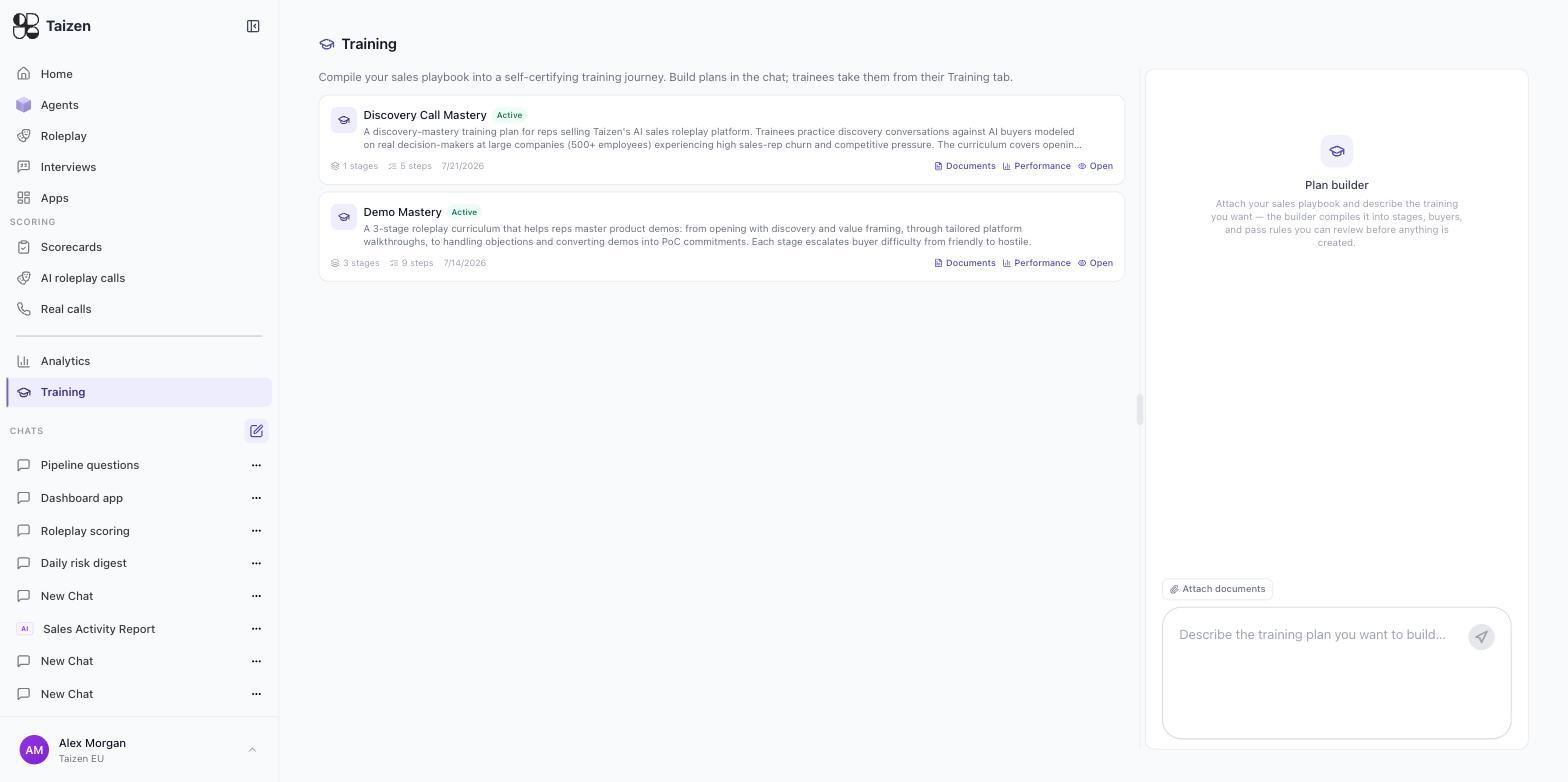
Training in the sidebar lists your plans. Each shows how many stages and steps it has, when it was last updated, and whether it's Active, plus links to its Documents and its Performance.
On the right sits the Plan builder. It's a chat, not a form: Attach documents to give it your playbook, then describe the training you want in a sentence. It compiles that into stages, buyers and pass rules and shows you the plan for review — nothing is created until you approve it.
Reps take assigned plans from their own Training tab.
What a plan looks like
A real plan, as it appears in the product:
Discovery Call Mastery — rep readiness across 5 escalating roleplays, from warm intro to hostile-buyer certification. 1 stage, 5 steps.
Each step is a roleplay against a bot with a scorecard attached, and a score the rep has to reach.
Why escalation matters
A rep who can handle a receptive buyer has learned nothing about the deal they're going to lose. The curriculum works because the buyer gets harder:
- Warm intro — a receptive buyer. Builds the motion.
- Needs analysis — a buyer with real constraints who doesn't volunteer them.
- Pain quantification — a buyer who has the problem but won't put a number on it.
- Objection handling — a buyer with a live objection and a competitor in play.
- Hostile certification — a sceptical buyer who guards budget and pushes back on everything.
What plans are built from
Plans read from your document stores — your playbook, pricing, competitive one-pagers, product docs. That grounding is what makes the buyer object to your actual prices and your actual positioning rather than a generic version of them.
The Documents link on each plan shows what that plan is grounded in.
Where the material comes from
The best drills aren't invented. They come from:
- Lost deals. A win/loss interview gives you the objections a real buyer actually raised. Build the stage from those.
- Real call scores. If scoring real calls shows the team is weak on one dimension, that's the stage to add.
- Competitive changes. When a competitor moves, the objection changes; the drill should change with it.